
If you enjoy mathematics, statistics, and data analysis, and aspire to work in insurance companies, banks, or global financial institutions, then actuarial science might be the ideal choice for you. This field combines mathematics, economics, statistics, and risk management, and is one of the most in-demand and highest-paying specializations worldwide.
Studying actuarial science in Turkish Cyprus
Quick facts about the actuarial science major
| Item | Details |
|---|---|
| Program Name | Actuarial Science |
| Study Duration | 4 years |
| Language of Instruction | English |
| Degree Awarded | Bachelor’s Degree |
| Career Opportunities | Insurance companies, banks, investment firms, financial consulting companies, pension funds, financial technology (FinTech) companies |
| Demand Level | High worldwide |
| Required Skills | Mathematics, statistics, analytical skills, logical thinking, problem-solving |
| Internship Opportunities | Available in financial institutions and insurance companies, depending on the university |
| Graduate Study Options | Master’s and Ph.D. programs in Actuarial Science, Risk Management, or Finance |
What is Actuarial Science?
Actuarial Science is a multidisciplinary field that combines mathematics, statistics, economics, finance, and risk management. It focuses on analyzing financial risks and predicting future events using mathematical models and statistical data.
Actuarial professionals use quantitative analysis to assess the risks faced by insurance companies, banks, pension funds, investment firms, and other financial institutions. Their work helps organizations make more accurate, informed, and sustainable financial decisions.
Why is it Called Actuarial Science?
The term Actuarial Science is derived from the word Actuary, which is the professional title for an expert who analyzes financial risks using mathematics, statistics, and data analysis.
This field is called Actuarial Science because it applies scientific methods, mathematical models, and statistical techniques to estimate the likelihood of future events—such as accidents, illnesses, natural disasters, and life expectancy—and to evaluate their financial impact on individuals, businesses, and organizations. These insights enable institutions to manage risk effectively and make well-informed financial decisions.
What Do Actuarial Science Students Study?
Actuarial Science students study a wide range of subjects that prepare them to analyze data, assess risk, and make informed financial decisions. The core areas of study include:
- Applied Mathematics
- Statistics and Probability
- Financial Mathematics
- Microeconomics and Macroeconomics
- Accounting and Finance
- Risk Management
- Insurance and Reinsurance
- Data Analysis
- Programming and Statistical Software Applications
- Financial Modeling
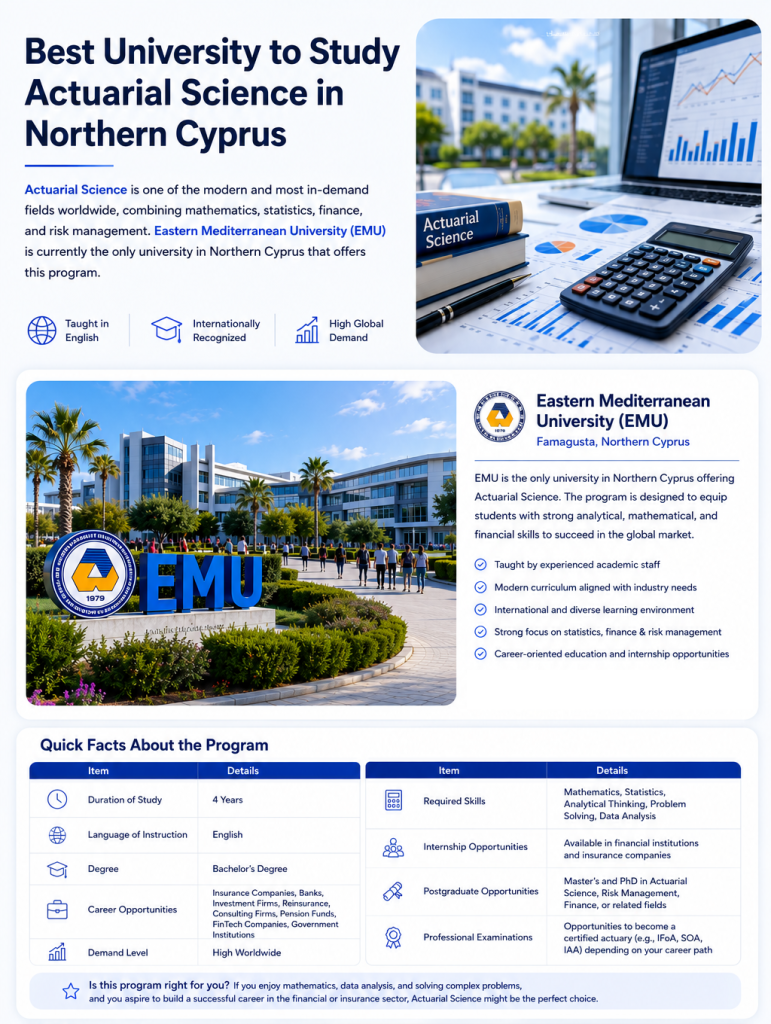
Best University to Study Actuarial Science in Northern Cyprus
Actuarial Science is a modern and globally in-demand field. In Northern Cyprus, the program is currently offered by Eastern Mediterranean University (EMU), making it the only university in the region that provides this degree.
Eastern Mediterranean University is well known for its strong academic reputation and for offering programs that align with the needs of the global job market. The university provides the Actuarial Science program in English within an international learning environment, making it an excellent choice for students seeking a high-quality education and strong career prospects.
What Career Opportunities Are Available for Actuarial Science Graduates?
Graduates of Actuarial Science have a wide range of career opportunities across the financial and risk management sectors. They can work in:
- Insurance companies
- Banks
- Investment firms
- Reinsurance companies
- Consulting firms
- Financial technology (FinTech) companies
- Pension funds
- Government institutions and regulatory agencies
If you wish to gain admission to a university in
Turkish Cyprus,
you can contact the Real Education team for a free consultation and assistance in choosing the right university and major.